Home › Services
Storm damage tree removal around Springfield, Missouri
Storm damage tree removal is a different job from ordinary removal, and the difference starts with the weather that caused it. Ice loads a tree one way, straight line wind another, and saturated karst ground a third. Each leaves the tree in a different condition, and each calls for a different order of cuts. What follows explains how trees actually fail around Greene County, what a homeowner should do in the first hour after one comes down, and which damaged trees are worth keeping.
Ice is the local failure mode that matters most
Freezing rain does not blow a tree apart. It coats it. Every twig, bud and needle picks up a layer of clear ice, and because a mature crown carries an enormous amount of small surface area, the weight added is far greater than the thickness of the ice suggests. The load arrives evenly across the whole crown, and it keeps building for as long as the rain falls and surfaces stay below freezing.
That is what separates ice from wind. Wind comes in gusts and lulls, so a tree bends, sheds some energy and recovers between them. Ice offers no lulls. The load only increases, and it stays until the melt. Failure comes when the accumulated weight exceeds what the weakest fork can hold.
Ice punishes crowns built from many small upright branches, because that structure carries the most surface area for the least wood strength. It also punishes the tight seam-filled fork, which offers a ready-made place to break. Bradford pear is the clearest local example, with silver maple and elm close behind, and the home page explains what is wrong inside those unions.
A well formed oak of the same trunk size often rides the same storm out: its limbs leave at wide angles with real wood in the union, there are fewer of them, and there is less fine twig surface to collect ice. The January 2007 ice storm was severe around Springfield, and its signature is still readable in older trees here, in flat topped crowns where a leader came out and dense regrowth from limbs cut back to stubs.
Windthrow, shallow roots and trees with nothing wrong with them
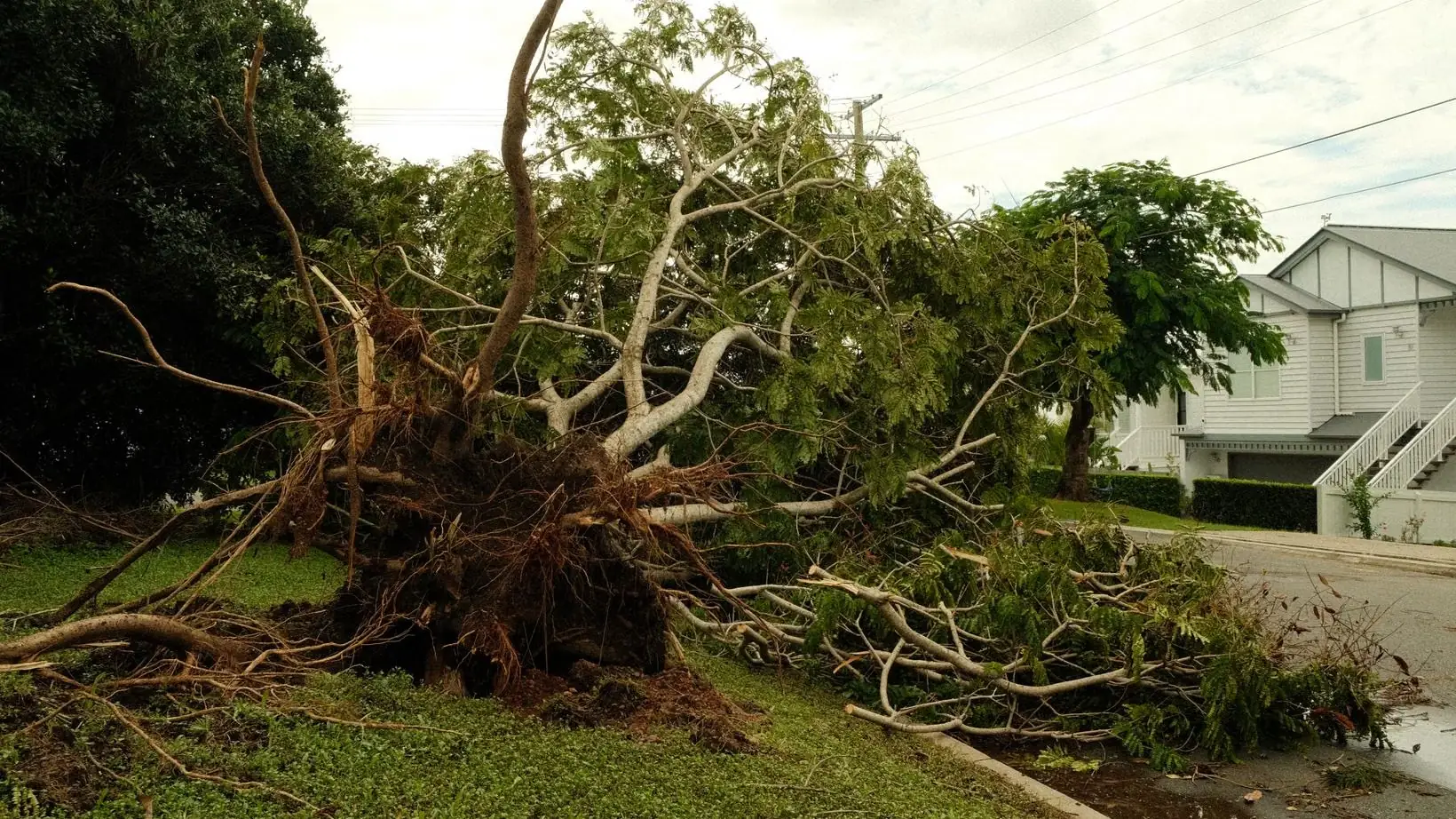
The local geology is covered on the home page, and it matters here for one reason: shallow bedrock leaves a tree no way down, so its roots build outward into a wide plate instead of an anchor. On a large specimen that plate reaches past the drip line and still sits within the top few feet of ground.
A root plate holds a tree up the way a wide footing holds a post, by resisting rotation, and the holding is done by soil gripping roots as much as by root wood. Saturate that soil and it loses much of its strength. Put wind into the crown, which is a long lever on a short foundation, and the whole plate can turn. The tree tips with its roots still attached, levering up a disc of soil and turf on the side away from the fall.
This is why trees with no decay at all come down here. No cavity, no fungus at the base, nothing a homeowner could have spotted: the failure was in the ground, not the wood. It also explains why the dangerous sequence is heavy rain followed quickly by wind. Several inches on thin soil over rock, then a front that night, takes down trees that stood through windier days on dry ground.
Spring brings the other kind of event, tornadoes and straight line wind, which load a whole crown in one direction and hold it there. The stem can fail, usually at a defect, an old wound, a decay column or a point of little taper, and the crown snaps off mid trunk. Or the stem holds, the ground gives, and the whole tree lays over with its root plate lifted.
What is left behind differs. A snapped trunk leaves a standing spar with a torn top and often pieces hanging in the remains of the crown. A laid over tree leaves stored tension, a butt that wants to move, and a hinge of roots still partly connected.
What to do in the first hour, before anyone arrives
Many of the serious injuries after a storm happen to homeowners rather than crews, in the first day, while someone is looking at the damage instead of working on it.
Photographs are worth taking carefully, for the homeowner's own record: wide shots of where the tree stood and what it hit, closer shots of the break or the lifted roots, and shots of the structure before anything is dragged off it. Once cleanup starts, the scene is gone. Creaking matters more than it sounds. A tree on a structure has put a load somewhere the building was never designed to carry it, and the noises it makes while that load settles are the warning worth heeding. A sagging ceiling, a door frame out of square, a groan when the wind rises: get people outside.
- Treat every downed or sagging wire as live, keep everyone well back, and call the utility.
- Do not stand or walk under a partly fallen tree or a limb hung up in the crown.
- Rope or tape off the ground under a hung up limb so nobody wanders into it.
- Leave a tree resting on a roof where it is until someone can rig it off in pieces.
- Do not put a chainsaw into a leaning tree whose root plate has lifted.
- Photograph everything from several angles before anything is moved.
- Get everyone out of the structure if a ceiling sags or anything is creaking.
Anything touching an overhead line is a utility emergency
A tree or limb touching, leaning into, or fallen across an overhead electric line is not tree work. It is a utility emergency, and the only correct first call is to the utility. City Utilities of Springfield handles line clearance around its own electric lines, and getting a line cleared or de energized is their work, not something a tree service should be touching.
Assume any downed line is live. A wire on the ground can be energized without arcing, sparking or moving, and one that looks dead may be waiting on a reclosing device down the road. Wet wood conducts, so a limb resting on a line is part of the circuit, and so is the fence it leans on and the puddle around it. Keep well back, keep other people back, and keep pets and children inside. The utility deals with the conductor first, and a contractor picks up the tree work afterward.
Hung up limbs, loaded trunks and trees resting on a roof
A broken limb that has not reached the ground is the most dangerous thing in a storm damaged tree. The old name for it is a widow maker, because almost nothing is holding it: a few unbroken fibers, a strip of bark, friction against another limb. It can release with no warning and no wind, hours or days later, as those fibers creep or the bark dries and lets go. Rope off the ground beneath it and stay out of that circle.
A tree lying on a roof is where instinct is most often wrong. Dragging it off in a hurry is usually worse than leaving it, because the tree may be the only thing holding its own weight in place and spreading it across several rafters. Pulling it sideways concentrates everything at one point, tears sheathing, rakes shingles off, catches a ridge, or pulls at a wall. A tree that did modest damage falling can do far more coming off badly.
The right approach is someone who can rig it off in pieces, working from the outside in, with each piece roped or lifted rather than allowed to roll. That is slow, it sometimes needs a crane or a lift in the yard, and it is worth waiting for: a tarp over an opening beats a hole in the roof and a tree in the flower bed.
A leaning tree whose root plate has lifted is under tension, and the plate behaves like a wound spring. Cut the trunk and that energy goes somewhere: the butt kicks, the plate slams back into the hole, the trunk rolls, or the top swings through the yard. Add mud, a slope, and a bar that pinches in a loaded cut, and this is the classic way a homeowner gets hurt with a saw. It is not homeowner chainsaw work.
Storm damage tree removal Springfield MO takes longer, and why
Taking down a standing tree on a calm day is predictable: the wood is where it grew, the loads are the ones gravity has always applied, and the person cutting chooses the order of events. A storm tree is the opposite. Everything in it has already moved, and the loads are whatever the fall left behind.
The specific hazard is wood under spring tension. A bent limb stores energy like a drawn bow, with one face in tension and the other in compression, and a cut on the wrong face either pinches the bar or releases the piece so it whips through an arc nobody planned for. Limbs that came down in a pile are bound against one another, each holding the next, and the tension paths are invisible from outside the pile, so moving the wrong piece shifts three others. The footing compounds it: mud, torn turf, holes where a root plate lifted, fence wire and glass in the debris, ice underfoot after an ice event, and rarely a clean drop zone left anywhere in the yard.
So a contractor working a storm tree does something that looks slow from the street. They read the tree first, then release tension in a planned order: the outermost and least loaded pieces first, loaded wood cut in stages from the compression side so it settles instead of springing, and rope on anything whose free fall would be uncontrolled.
Emergency tree removal Springfield MO: how triage works
After a widespread ice or wind event everybody in the area calls at once, and calls get answered by hazard rather than in the order they arrived. A tree on an occupied house, a limb hanging over a bedroom, a trunk across the only way out of a drive, anything tangled with a line: those come first. A large oak lying flat and harmless in a pasture, with nothing under it and nobody near it, will wait days, and it should.
How a homeowner describes the situation determines where it lands, so the useful details are what the tree is touching, whether any part of it is on or near a line, whether anyone is blocked in, and whether a limb is hanging rather than down. Species and diameter matter far less. It is also normal for the first visit to be a make safe visit rather than a full cleanup: a hanging limb down, a trunk cut clear of a drive, weight off a roof, with the wood and brush left for a return trip.
Which damaged trees can actually be kept
Not every storm damaged tree is a removal. The rough working rule involves crown loss and the leader: a tree that has lost less than about a third of its crown, with its main leader intact and no damage at the trunk or root, usually recovers on its own over a few seasons. It has enough leaf area left to feed the roots and rebuild, and it still has the framework that decides its future shape.
The cases that generally do not come back deserve naming plainly. A split trunk, where a crack runs down out of a fork into the stem, does not knit. The fibers are broken, and the tree can only grow over the outside of the wound, leaving the crack inside as a permanent plane of weakness that opens in the next comparable event. A young tree that lost its leader answers with several competing shoots at the break, which grow fast and crowd each other, building the included bark fork that fails later.
A tree that has moved at the root is finished as a stable tree, and that is the part homeowners most want to argue with, because it is standing and the leaves are still green. Anchorage was being done by fine roots in intimate contact with soil, and those have been torn. New roots grow, but from where the plate sits now, into disturbed soil. A mature tree pushed upright and staked never re-anchors the way it was, though small nursery stock is a different matter. An arborist's opinion is worth getting on a tree the homeowner would rather keep.
Repair pruning done right, and why topping makes it worse
Once the hazard is gone, the follow up work on a keepable tree is repair pruning, and it is simple in principle. Torn and shattered wood gets cut back to a proper final cut at the branch collar, the slightly swollen ring of tissue where a limb meets the stem. The collar is what grows over the wound, so the cut goes just outside it and leaves it intact. A flush cut removes that ability to close, and a long stub dies back into a decay route.
What repair pruning is not is an occasion to top the tree. Topping, cutting large limbs back to stubs to make a tree shorter, strips leaf area when the tree needs it most, leaves large wounds in the crown that never close, and forces regrowth from latent buds just under the bark, so the new shoots are attached only to the outer layer of wood rather than anchored in the stem. That makes the next failure worse: in ten years the tree carries a thicket of fast grown, weakly held shoots on stubs that have decayed the whole time, and it offers more twig surface for ice to load. The 2007 storm produced many topped trees around Springfield, and a fair share of today's limb failures happen at those old cuts.
Timing has one local wrinkle. Oak wilt, covered at length under tree health, punishes warm-season wounds, so tidying up a damaged oak is better postponed until the tree is dormant. A limb that is an immediate hazard comes off whenever it has to.
Prevention that helps, and what no amount of pruning fixes
Storm work is mostly reactive, but a few things change how a tree behaves in the next event.
The dead ash item deserves emphasis, because it is a timing problem more than a tree problem. Missouri ash lost to the borer does not stay sound where it stands. The wood turns glassy, sheds limbs unpredictably, and eventually rules out climbing altogether. Handled while the fibers still hold together, the same tree is an ordinary job.
The honest limit is worth stating plainly: no amount of pruning makes a tree ice proof. Ice load scales with the twig surface a tree carries, and a healthy tree carries plenty. Structural pruning changes the odds and changes where a failure happens, but it does not remove the risk. For species built to fail, the real answer is to plant something else and let time do the rest.
- Removing deadwood, which is the first thing out of a crown in any wind.
- Correcting included bark forks and competing leaders while a tree is still small.
- Taking down ash killed by emerald ash borer before the wood turns brittle.
- Shortening long, heavy horizontal limbs that reach over a roof or a drive.
- Keeping fill, trenching and equipment off a root plate that is shallow and wide.
Storm damage tree removal around Springfield, Missouri — common questions
A tree fell into the power line along the street. Who should be called first?
The utility, before anyone else. A tree or limb touching an overhead electric line is a utility emergency rather than tree work, and City Utilities of Springfield handles line clearance around its own electric lines. Assume the line is live even if nothing is arcing or humming, because a downed conductor can be energized silently, and wet wood, wet fences and standing water all conduct. Keep everyone well back, keep pets and children inside, and do not try to move branches off the wire. Once the line has been dealt with, a tree service can handle whatever is left of the tree.
Should a tree lying on the roof be pulled off right away?
Usually not. The tree is often the only thing holding its own weight in place and spreading it across several rafters, and dragging it sideways with a truck concentrates that load at a single point, tears sheathing, rakes off shingles, and can pull at a wall. Plenty of houses take more damage during a hurried removal than they did in the fall itself. The better sequence is to tarp what is open, stay out of the rooms underneath if anything is sagging or creaking, and wait for someone who can rig the tree off in pieces rather than drag it.
Can a tree that lost a lot of its crown in an ice storm be saved?
It depends on how much came off and what went with it. A tree that lost less than roughly a third of its crown, with the main leader intact and no damage at the trunk or the root, usually recovers over a few seasons once the torn wood has been cut back properly at the branch collar. A split trunk, a young tree that lost its leader, or any tree that moved at the root is a different story and generally will not come back as a sound tree. For borderline cases, waiting one full growing season before deciding is reasonable, as long as nothing is left hanging.
Why does storm damage removal take longer than a planned tree removal?
Because the wood is loaded in ways it never grew for. Bent limbs hold spring tension and whip when released, piled limbs are bound against each other so moving one shifts three more, and a lifted root plate stores energy that goes somewhere the instant the trunk is cut. On top of that, the footing is mud and debris, and there is rarely a clean drop zone left in the yard. A contractor has to read the tree and then release tension in a planned order, working from the least loaded pieces inward, which is slower than felling the same tree intact.
How long does it take for someone to come out after a regional storm?
After a widespread ice or wind event, expect calls to be answered by hazard rather than in the order they came in. Trees on occupied houses, limbs hanging over living space, trunks blocking the only way out, and anything tangled with a line get attention first. A tree lying harmlessly in a pasture may wait several days. Describing the situation accurately helps: what the tree is touching, whether a line is involved, whether anyone is blocked in, and whether something is hanging. The first visit is often a make safe visit, with wood and brush cleaned up on a later trip.
A tree is leaning after the storm but the leaves are still green. Is it stable?
If the lean is new and the ground has heaved or a circle of turf has lifted on the far side, the tree has failed at the root and is not stable, however healthy the crown looks. Anchorage came from fine roots in close contact with soil, and those have been torn. New roots grow from wherever the plate sits now, in soil that has been disturbed, so the tree never re-anchors the way it was. Pushing a mature tree upright and staking it does not fix that. Treat it as a hazard and keep people out from under it.
Does topping a storm damaged tree make it safer?
No, it makes the next failure worse. Topping strips leaf area when the tree needs it most, leaves large wounds in the crown that never close, and forces regrowth from latent buds just beneath the bark, so the new shoots are attached only to the outer wood rather than anchored in the stem. Within a decade the tree carries a thicket of fast grown, weakly held shoots sitting on stubs that have been decaying the whole time, plus more twig surface for ice to load. Proper repair cuts back to the branch collar are the alternative.
Talk through your site
Start with the address, what you want done, and a few photographs of the area, including anywhere water sits after a heavy rain.
Related work
Tree Removal
Taking a tree down safely when it is dead, failing, or standing too close to something it can reach.
Tree Trimming & Pruning
Cuts that reduce weight and risk without stripping a tree of what keeps it alive.
Stump Grinding & Removal
Grinding a stump out, how deep is deep enough, and what to do with the hole and the chips.
Tree Health & Disease
Reading decline in oak, ash and pine on thin Ozarks soil, and telling a treatable problem from a hazard.
Lot & Land Clearing
Opening up overgrown acreage, fencelines and building sites, including honeysuckle and cedar.
Across the metro
Nixa
Christian County subdivisions carved out of old oak woodland, with mature trees left standing close to new houses.
Ozark
Finley River bottoms and steep wooded lots where sycamore and silver maple grow fast and fail early.
Republic
Open prairie edge west of Springfield, where wind arrives with nothing to slow it down.
Willard
Rolling pasture and fencerow cedar north of town, with hedge and volunteer trees crowding property lines.
Battlefield
Established southwest-side neighborhoods with large old post oaks over roofs and driveways.