Home › Services
Tree removal in Springfield, MO: how a contractor decides a tree has to come down
Tree removal is the one piece of tree work that cannot be taken back, so the decision deserves closer scrutiny than the job itself. Around Springfield, most trees that come down are not simply old. They are trees whose remaining sound wood no longer matches the load they carry, standing where a failure would land on something that matters. What follows is how that judgment gets made on an Ozarks property, how a removal is actually carried out once it is decided, and what a homeowner should have in writing before anyone starts a saw.
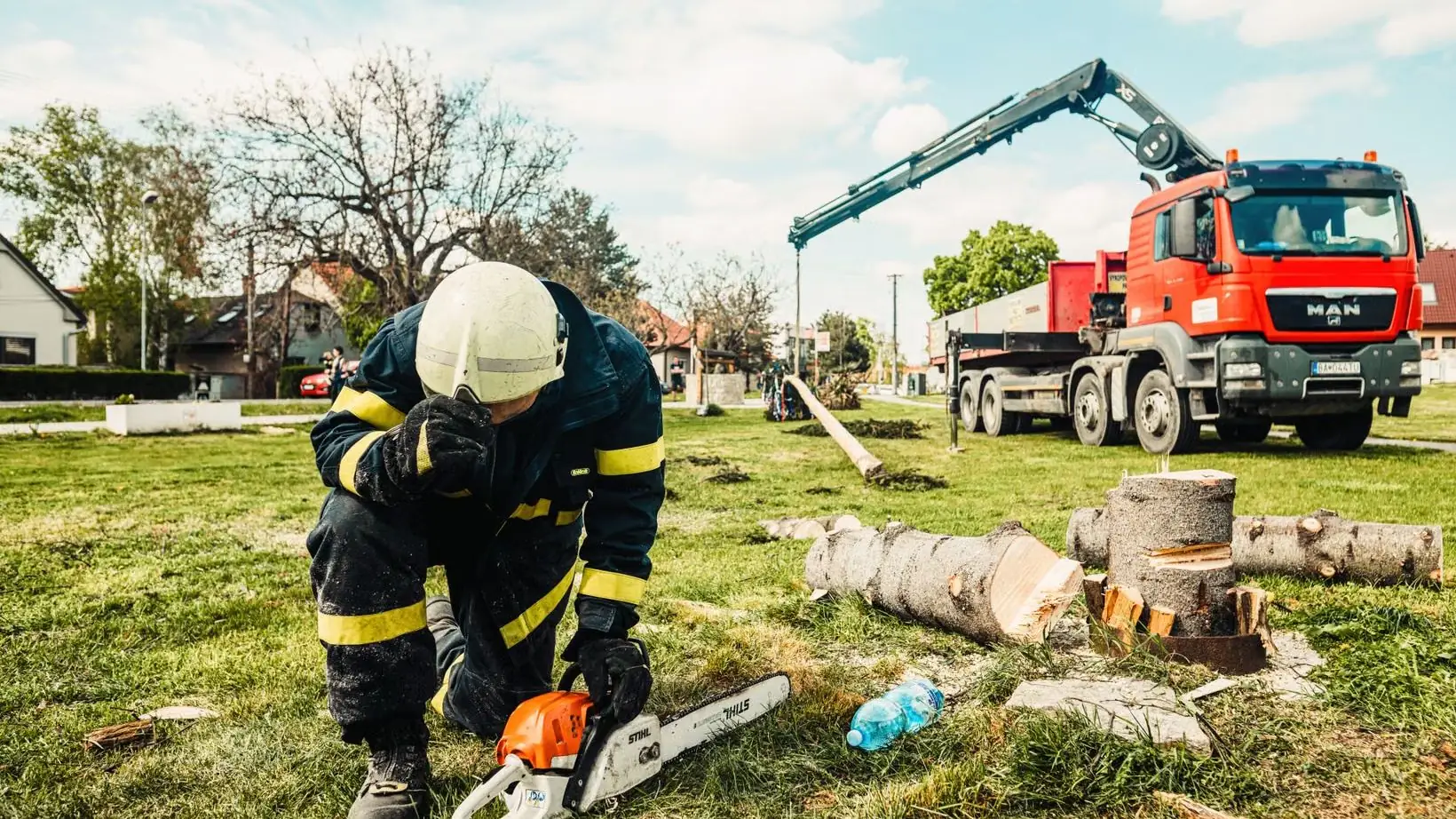
Removal or pruning: what actually decides it
Two things decide whether a tree is pruned or taken down: how much sound wood is left holding it up, and what the tree can reach if it comes apart. Neither settles the question alone. A contractor who weighs only one of them condemns trees that could have been kept and leaves standing ones that should already be gone.
Sound wood matters more than total size because of the way a trunk carries load. Strength lives in the outer shell of wood rather than the core, and a trunk resists bending roughly the way a pipe does. That is why a tree can be hollow through the middle and stand for decades, and why losing the outer inch or two to decay costs far more strength than the same volume rotted out of the heart. The question is not whether decay is present, but how thick the remaining sound wall is against the trunk diameter, and whether it runs all the way around or has an open face.
Then there is the target, the plain word for whatever sits under the tree. A post oak with a cracked fork over open pasture and the same post oak with the same crack over a bedroom are not the same decision, because one failure costs firewood and the other costs something that cannot be replaced. Consequence is half the arithmetic, which is why a homeowner may hear that a tree is coming down for where it stands rather than for how sick it looks.
Reading the defects that push a tree toward removal
A useful inspection starts at the ground and works up, on every side of the tree. Most of what condemns one is visible from the yard.
Fungal fruiting bodies grow outside the tree to shed spores, so the decay behind them has been working inside the wood for years. Location decides how much it matters. Hard, shelf-like conks at the base or on the buttress roots are the serious version, because that is the wood resisting overturning and nothing prunes around a failing base. Struck with a mallet, solid wood returns a dull thud and decayed wood a lighter, more resonant note.
Vertical cracks are the tree telling on itself. Wood splits along the grain when a stem is bent past what it can take, and a crack that reopens after every windstorm is a hinge forming. Included bark is the related defect, and the reason Bradford pear fails so reliably here: where two stems press together at a narrow angle, the bark caught between them never knits into connecting wood, so the union is a seam rather than a joint. It splits under the even, accumulating weight of freezing rain.
Deadwood high in the crown says more than deadwood low inside it, because the top is the hardest place for a tree to push water to and the first thing it abandons when roots fail. Two consecutive thin springs point the same way: one year of small, pale leaves can be weather, two running usually means reserves that never came back. A trunk that goes into the ground with no widening flare usually means fill dirt or years of mulch against bark that then stayed wet and decayed at the root collar.
- Hard, shelf-like conks at the base or on surface roots
- A trunk that sounds drummy rather than dull
- Vertical cracks that stay open in cold weather
- Tight forks with bark trapped in the seam
- Bark coming off in sheets
- Deadwood concentrated in the upper crown
- Two springs running of small, pale leaves
- No visible trunk flare at the soil line
Lean: the tree that always leaned and the tree that just moved
A leaning tree is not automatically a hazard, and what matters is whether the lean is old or new. A tree that grew leaning has been adding wood on the loaded side its whole life to compensate. The signs are a trunk that curves and then straightens toward vertical near the top, and a thickened base on the low side.
A tree that recently moved looks different. The stem stays straight and the whole tree tips, so the lean has no curve and the crown points off at an angle instead of turning back up. The urgent evidence is at the ground, on the side opposite the lean: a low mound of lifted turf behind the trunk, or a curved crack in the sod several feet back from the base. Either one means the anchorage is already partly gone.
Springfield ground changes those odds. The Springfield Plateau is karst country, with limestone close to the surface and thin soil above it, so roots that cannot go down go out instead and trees anchor in a wide shallow plate rather than a deep cone. That plate holds well in ordinary weather and poorly once saturated, which is how a tree with no decay in it comes over in a spring storm and takes a circle of turf with it. Grading, a trench cut for a line, or a patio poured across one side of the root zone all shrink the plate that is holding.
How a removal is done, and why the method drives the job
Most of what separates an easy removal from a hard one is not the tree but how much room there is around it. Three approaches cover nearly every job, and which applies decides how long the work takes and what the lawn looks like afterward.
Felling in one piece is fastest and cheapest, and available far less often than homeowners assume. It needs open ground roughly as long as the tree is tall, in a direction the tree can be persuaded to go. On acreage out toward Republic or Willard that is often the case. On an in-town lot with a house, a garage, a fence and a neighbor inside that radius, it is not.
Sectional dismantling is what happens instead. A climber takes the crown apart in pieces small enough to control, lowering each one on a rope through a rigging point set higher in the tree, then reduces the trunk in blocks from the top down. It is slower and takes more skill, and the tree never falls as a unit. Lowered on a line and dropped free are different things, and the difference shows on the turf.
A crane or a large lift enters the picture when the drop zone is occupied by something that cannot be moved, or when the rigging points in the tree cannot be trusted. A crane holds each piece before it is cut and carries it out over the roof to a landing area. It needs room to set up, clearance overhead, and ground that will carry the weight.
The question worth asking directly is where the drop zone is and where the wood will be stacked. That answer explains most of the plan: which part of the yard gets worked hardest, and how much of the job happens over the roofline.
Dead ash: the removal that gets harder every season it waits
Ash killed by emerald ash borer is its own category. The larvae feed just under the bark and cut the pathways moving food between crown and roots, so an infested ash dies from the top down. What matters for removal is the wood afterward: dead ash dries fast and turns brittle, snapping without bending and breaking at the top where nothing looked wrong.
That removes the safest option. Climbing means trusting the tree to hold a person, and a dead ash cannot be trusted that way, least of all at the top where the wood is thinnest and has been dead longest. Rigging is no better, because a point set in brittle wood can let go under the shock of a piece being caught. So a dead ash usually has to come down mechanically, from a lift or with a crane.
The consequence is timing. An ash taken down within a year or two of dying can often still be handled the ordinary way. The same tree three or four years later needs equipment, needs room to bring it in, and sheds limbs while it waits. A thinning top, sprouts on the lower trunk, and bark that woodpeckers have flaked off are reasons to have it looked at before another winter.
What is under the tree, and how equipment gets to it
Removals go wrong below grade more often than above it. The tree comes down cleanly and the damage found afterward is a crushed lateral line, a bent well casing, a cut irrigation zone, or a driveway edge broken where a truck turned on it. None of it is visible to a crew that was never told.
Access decides how much of the job happens by hand. A truck and chipper that can back to the tree turn brush into a short trip; the same tree reached only through a garden gate means every limb is carried or winched out through that opening. Measuring the narrowest point on the route takes five minutes and changes the plan.
Ground conditions matter just as much here. Thin soil over rock saturates quickly and drains slowly, and a yard that looks merely soft will rut under a loaded truck in one pass. Ruts also compact the soil beneath them, which is why grass in a wheel track struggles for a season. On work that is not urgent, waiting out a wet week is the cheaper choice for the lawn.
- Septic tank, distribution box and lateral field, which take no truck weight
- Well head and the buried line to the house
- Buried electric, gas, water and communications lines, including runs to a shed
- Irrigation heads, valve boxes and low-voltage lighting wire
- Driveway and sidewalk edges, which break under turning loads
- Patio slabs, retaining walls and raised beds
- Fence lines and gate widths on the route in
- Shed and garage roofs within reach of the tree
Trees touching overhead electric lines are not a tree service job
A tree growing into primary electric conductors is not a homeowner's problem to solve or a tree contractor's to bid. Springfield's municipal electric provider, City Utilities, keeps its own conductors clear, and the correct first step is a report rather than a saw.
Knowing which wire is which helps, because it changes who to call. The higher wires on a pole carry distribution voltage and belong to the utility. The service drop from the pole to the house, and the smaller television and telephone cables, are a separate conversation. A removal near any of them may need the drop lowered or sleeved for the day.
The line is drawn this firmly because electricity does not require contact to be dangerous, and a wet limb or a wet rope can complete a path at surprising distance. Where a limb overhangs a line, expect the sequence to include a call and a wait, and treat that wait as part of doing the job properly.
Right-of-way trees, city ownership, and subdivision rules
Not every tree in front of a house belongs to the person who mows around it. The strip between the sidewalk and the street is often public right of way, and trees standing there are commonly the city's, which makes removal and pruning the city's decisions rather than the owner's. The way to settle it is to ask the city before collecting quotes, working from the property line and the right of way width rather than from where the mowed lawn appears to end.
Subdivision covenants are the second layer, private rather than municipal. Newer neighborhoods around Springfield, Nixa, Ozark and Battlefield often carry recorded restrictions that reach trees: which species may go in a front yard, whether a healthy tree above a certain size can be removed at all, and sometimes who has to approve the work.
The habit that avoids trouble is to settle ownership and permission first and the arboriculture second. Trees on or near a property line also deserve an early conversation with the neighbor, since access is usually needed.
What removal includes, what it does not, and getting it written down
The word removal covers a wide range of finished conditions, and most disputes over tree work trace back to two quotes that used the same word for different jobs. A proposal that spells out the end state lets a homeowner compare like with like and gives the crew an unambiguous target. Every line below is worth settling in writing.
- Stump: cut flush, cut low, or ground, and if ground, how deep and how wide
- Grindings: hauled off, or left mounded over the hole
- Wood: hauled away, cut to stove length and stacked, or left in rounds
- Brush and chips: removed entirely, or blown into a bed on site
- Surface roots: left in place, or chased out within the graded area
- Turf: rake and cleanup only, or ruts filled and seeded, and by whom
- The stump hole: backfilled with soil, or left to settle
- Access route and parking for the truck, chipper and any lift or crane
Timing a removal through the Springfield year
A removal can be done in any month, but the calendar changes how hard it is. The dormant season is the quiet advantage: a bare tree is lighter and easier to see into, a climber can read the structure, and brush volume drops sharply without leaves.
Frozen ground is the winter advantage homeowners notice most. Frozen soil carries equipment without rutting or the compaction that follows a rut, so the truck that would leave tracks across a soft April lawn crosses a hard January one and leaves almost nothing.
Oaks carry one seasonal restriction, for disease reasons covered on the trimming and tree health pages: cutting into a live oak during the warm half of the year invites oak wilt, so planned oak work waits for cold weather. Genuine hazards do not wait. When an oak limb hanging over a driveway has to come off in June, it comes off, and the wound is usually sealed right away rather than left open.
Every ice storm produces more emergency work than any market has crews for, and the trees seen first are the ones on houses and across roads. The January 2007 ice storm still shows in the shape of older trees here, and the ones it broke were mostly trees whose defects were already there to find.
The gap the tree leaves, and what the rest of the yard does next
A removal changes the yard beyond the stump, and the change that surprises people is wind. Trees that grew up in a group sheltered each other, and their trunks and roots grew only as strong as the loads they actually met, which were modest in the middle of a stand. Take out the tree on the windward side and the ones behind it are suddenly carrying gusts they have never felt. It is worth asking which neighbors are about to become exposed while the tree is still standing.
Light and water shift as well. The ground under a mature tree was dry and shaded and afterward is neither, so shade plantings struggle in full sun while the soil the tree was drinking from stays wetter.
On replanting, the useful principle is to choose for the space rather than for the gap. The old footprint is a poor guide, because whatever caused the removal may be the same crowding or the same buried line that will limit the next tree. Species suited to thin soil over limestone do better here than fast growers: post oak, white oak, shortleaf pine, eastern red cedar, black walnut, hackberry, sugar maple, redbud and flowering dogwood. Bradford pear and silver maple do not, the pear splitting at its included forks and the maple growing weak wood that sheds limbs. Neither is a sensible choice for a spot that has just been cleared at some expense.
Tree removal in Springfield, MO — common questions
How does a contractor decide a tree needs removal instead of pruning?
The decision rests on two things together: how much sound wood is left holding the tree up, and what the tree would land on if it failed. Strength lives in the outer shell of a trunk, so the measure that counts is the thickness of the remaining solid wall against the trunk diameter, and whether that wall is continuous or has an open face. Consequence carries equal weight. The same defect over open pasture and over a bedroom produce different answers, because one failure costs firewood and the other does not. Pruning can reduce load and take off a hazardous limb, but nothing prunes away a failing base or a moving root plate.
There are mushrooms at the base of my tree. Does it have to come down?
Not automatically, but it deserves a real look. Fruiting bodies are the outside part of a fungus that has already been working inside the wood for years, so they indicate decay further along than it appears. Location matters most. Hard, shelf-like conks on the trunk base or the buttress roots are the serious version, because that is the wood resisting overturning and it cannot be pruned around. Soft annual mushrooms scattered in the lawn are often feeding on old roots and mean much less. A contractor will pair what the fruiting bodies show with a sounding test and the condition of the crown before saying anything definite.
My tree leans. Is that dangerous?
It depends entirely on whether the lean is old or new. A tree that grew leaning spent its life adding wood on the loaded side, and it shows a curved trunk that straightens toward vertical near the top, usually with a thickened base on the low side. That tree built itself for its posture. A tree that recently moved leans as a straight stem with no curve in it, and the urgent evidence sits at the ground on the side opposite the lean: lifted turf, a low mound, or a curved crack in the sod several feet behind the trunk. That means the root plate is rotating out of the soil, which should be addressed immediately.
Why should a dead ash tree be removed sooner rather than later?
Because the wood keeps getting worse. Emerald ash borer larvae destroy the tissue just under the bark, and once an ash dies it dries out and turns brittle quickly. Brittle ash snaps without bending, drops bark in sheets, and breaks at the top where nothing looked wrong. That makes climbing it unsafe and makes rigging points set in it unreliable, so the tree usually has to come down mechanically from a lift or with a crane. An ash removed in the first year or two after dying is often a normal job. The same tree several years later needs equipment, needs room to bring it in, and drops limbs while it waits.
Does tree removal include grinding the stump?
Sometimes, which is exactly why it should be written into the proposal. Removal can mean the trunk cut flush at grade, cut low for later grinding, or ground out, and grinding itself varies in depth and width. The other loose ends belong in writing too: whether grindings are hauled off or left mounded over the hole, whether the wood leaves or is stacked as firewood, whether chips are removed or blown into a bed, and whether the hole gets backfilled. Two quotes that both say removal can describe quite different finished yards. Spelling out the end state makes them comparable and gives the crew a clear target.
What happens if a tree is touching power lines?
That is line clearance work and it belongs to the utility, not to a homeowner or a homeowner's tree contractor. Springfield's municipal provider, City Utilities, takes responsibility for the vegetation around its own conductors, so a tree touching them should be reported rather than cut. Which wire matters: the higher lines on the pole carry distribution voltage and are the utility's, while the service drop to the house and the smaller communications cables are a separate conversation. Electricity does not need direct contact to be dangerous, since a wet limb or wet rope can carry it. A contractor offering to work near primary lines without involving the utility should be declined.
Who owns the tree between the sidewalk and the street?
Often the city. That strip is commonly public right of way, and trees standing in it are typically municipal, which means removal, replacement and pruning are the city's decisions rather than the adjacent owner's. Hiring a contractor to take down a street tree without checking can leave a homeowner answering for a tree that was never theirs. The right move is to ask the city before collecting quotes, working from the property line and the right of way width rather than from where the mowed lawn seems to end. Recorded subdivision covenants are a second layer, and in newer neighborhoods they sometimes restrict removing or replacing yard trees as well.
What is the best time of year for tree removal around Springfield?
The dormant season, for several reasons. A bare tree is lighter and easier to read, rigging decisions are clearer without foliage, brush volume drops sharply, and beds underneath are dormant. Frozen ground is the bigger practical gain, because frozen soil carries equipment without rutting or the compaction that follows a rut. Oaks add one restriction: cutting into live oak wood during the warm half of the year risks oak wilt, so elective oak removal is scheduled for cold weather, with real hazards treated as the exception and their wounds sealed at once. Planning ahead also avoids the queue that forms after every ice storm.
Talk through your site
Start with the address, what you want done, and a few photographs of the area, including anywhere water sits after a heavy rain.
Related work
Tree Trimming & Pruning
Cuts that reduce weight and risk without stripping a tree of what keeps it alive.
Stump Grinding & Removal
Grinding a stump out, how deep is deep enough, and what to do with the hole and the chips.
Storm & Ice Damage
Ice loading, straight-line wind and windthrow, and what to do with a tree that is already leaning on something.
Tree Health & Disease
Reading decline in oak, ash and pine on thin Ozarks soil, and telling a treatable problem from a hazard.
Lot & Land Clearing
Opening up overgrown acreage, fencelines and building sites, including honeysuckle and cedar.
Across the metro
Nixa
Christian County subdivisions carved out of old oak woodland, with mature trees left standing close to new houses.
Ozark
Finley River bottoms and steep wooded lots where sycamore and silver maple grow fast and fail early.
Republic
Open prairie edge west of Springfield, where wind arrives with nothing to slow it down.
Willard
Rolling pasture and fencerow cedar north of town, with hedge and volunteer trees crowding property lines.
Battlefield
Established southwest-side neighborhoods with large old post oaks over roofs and driveways.