Home › Services
Stump grinding and stump removal in Springfield, Missouri
Grinding a stump looks like a small job next to taking the tree down, and it usually gets quoted and scheduled that way. It is also where a lot of the disappointment in tree work happens, because three words on a quote, grind the stump, do not say how deep, whether the surface roots go too, where the chips end up, or what happens when the teeth reach limestone. Around Springfield, that last one is not a rare event. What follows is what the machine actually does, and what a homeowner should settle before it arrives.
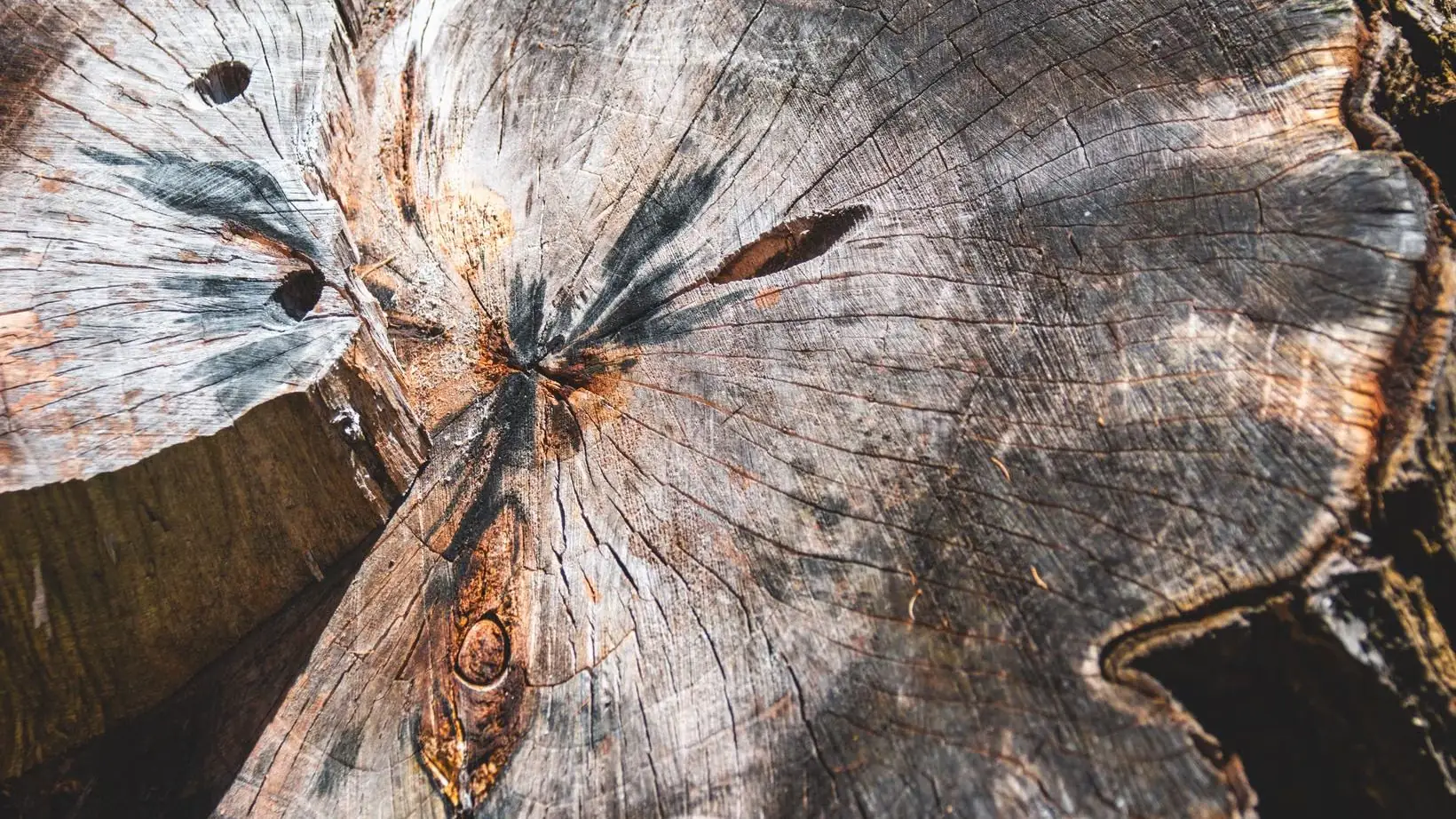
Grinding and full removal are two different jobs
A stump grinder is a wheel studded with hard cutting teeth that spins fast and is swept side to side across the wood, taking a shallow bite each pass. It pulls nothing out of the ground. It converts the stump, plus as much of the structural root flare as the operator chooses to reach, into a mixture of chips and soil that stays where the tree stood. What is left is the shape of the wood removed, not a crater.
Full extraction is a different operation. An excavator or a loader with a grapple works around the root plate, cuts the major roots and lifts the mass out, leaving an open hole that has to be backfilled with imported soil and compacted in layers so it does not sink later. It also disturbs a wide ring of lawn, and on a shallow-rooted tree in thin soil the roots run much farther out than down, so the damage is broad.
For nearly every yard, grinding is the better choice: faster, far less disturbance, no imported fill, and a site close to level the same day. Extraction earns its place in a few narrow situations.
- A building pad, slab or footing will sit on the spot
- The ground is being excavated anyway for a foundation or trench
- A driveway or retaining wall is being rebuilt through the location
- A new tree has to go in that exact hole
Depth is a decision, and it belongs in writing
Grind the stump is not a specification. The same stump can be taken a few inches below grade in one pass, or worked down a foot or more in stages, clearing the hole between cuts so the wheel keeps its reach. Machine geometry sets a practical limit: the wheel has to swing clear of the ground on every sweep, so depth is bought with repeated passes rather than with pressure. Each extra inch costs time, and time is what the job is made of.
How deep is deep enough depends entirely on what happens next, and the common answers sit far apart. For turf and a mower, the wood only needs to be low enough that a blade never finds it and soil can be placed over it, with the flare cut to the same level so no hard shoulder is left in the grass. For a fence post, a footing or a patio, the wood has to be clear of the excavation itself, because anything organic under a slab will decay and settle. For planting a tree in that same hole, grinding often cannot go deep enough to help at all.
This is the main reason two quotes for one stump differ, and the main reason a finished job disappoints: one contractor is pricing a shallow pass that makes the stump vanish from view, another repeated passes to a stated depth. A homeowner should say what the spot will be used for and get a depth in inches written on the quote.
Why a new tree struggles in a ground stump
Planting a replacement into the exact footprint is the most common request and the one most likely to end badly. Fresh chips are nearly all carbon and carry very little nitrogen. The fungi and bacteria that break them down need nitrogen to build their own cells, so they take it from the surrounding soil while they work. For as long as that decay runs, and in a deep pocket of chips it can run for years, the material in the hole competes with the new root ball.
Drainage in a ground-out pocket is also hard to predict. The hole is loose material ringed by undisturbed soil, and where thin soil sits over rock it can hold water like a bucket after a long rain, then dry out faster than the ground around it in July. The old root plate is still in place as well. Grinding removes the stump and the flare, not the wrist-thick roots running out through the soil, and a new root ball has to be wedged in among them.
The practical answer is to plant to one side. A few feet of offset puts the new roots into undisturbed soil with normal nitrogen and normal drainage. If the position truly cannot move, that is one of the narrow cases for extraction instead of grinding, with the hole backfilled with soil rather than chips.
The chip pile is bigger than the stump looked
Almost everyone underestimates the volume. A stump that looked like a low disc can produce a mound at knee height spreading several feet. Two things cause that. Chipped wood occupies far more space than solid wood, and the wheel cuts soil along with wood the whole time it works below grade, so what comes out is a wood and dirt mixture rather than clean chips. Grinding surface roots adds more soil still.
Three outcomes are normal, and they cost different amounts of labor. The mixture is raked back into the hole and mounded over the spot, which is the default. It is raked in with the surplus spread thin elsewhere as rough mulch. Or it is hauled off, which takes a truck, loading time and somewhere to put it. Anyone who wants it gone should say so while the quote is written.
A mound left over the hole will settle, and that is not a defect. Air pockets collapse, rain packs the material down, and the chips lose volume as they break apart, so a pile that looked excessive in spring can be a shallow dish a year later. That is why the spot needs topping with soil before anything is seeded. A soil and chip mixture is also a poor growing medium for grass: it drains oddly, it ties up nitrogen, and seed sown into it comes up thin and patchy.
Surface roots are a separate item, not an assumption
Around Springfield a large share of trees carry visible roots snaking across the lawn. That is what thin soil over limestone produces: roots that cannot go down go out instead, and the biggest end up at or just under the surface. Silver maple and sycamore are notorious for it. Once the stump is gone those roots are still there, still catching mower blades and still showing through the turf.
Grinding them out is slower work than grinding the stump, which is why it is normally a separate line rather than something included. The operator has to expose each root, follow it out from the flare and cut it in sections, repositioning constantly instead of working one fixed spot. The teeth spend most of that time in abrasive soil rather than clean wood. A single long root can take as much machine time as a modest stump.
The useful question is specific: which roots will be ground, and how far out from the trunk the work stops. Two feet of flare is a different job from every visible root out to the drip line, and the answer belongs on the quote beside the depth.
Where limestone sets the depth instead of effort
Bedrock lies within reach of a grinder wheel across much of this area, a condition the home page explains in full. It accounts for the wide, shallow root plates on trees here, and it accounts for something a homeowner deserves to hear before work begins. A wheel can reach stone before it reaches the depth that was agreed, and at that moment the ground decides the depth, not the operator.
Cutting teeth are made for wood and the soil mixed into it. Stone is another matter. Teeth striking limestone chip and dull quickly, the machine bucks, the sound changes, and pushing on gains no depth. What separates a good operator from a poor one is not whether rock is hit, which nobody controls, but whether it is reported plainly instead of quietly finishing shallow.
So the question during the estimate is what happens if rock turns up shallow. A reasonable answer sounds concrete: grind to whatever depth the stone allows, show the homeowner the hole, and explain what that depth means for the intended use. Rock can also change the plan outright. If the spot was meant for a footing and bedrock is a few inches down, the location or the design has to move.
What gets located and protected before the wheel turns
A grinding wheel destroys whatever it touches, and it throws chips, grit and the odd stone hard, low and wide. A careful crew sets plywood, mats or heavy blankets toward siding, windows, a glass door or a pool surface, moves vehicles rather than covering them, and keeps people and pets well back.
Most of what the wheel can hit is invisible from the surface. Public utility lines are handled by a free locate request placed before any digging, which brings crews to paint and flag buried services in the work area. City Utilities of Springfield handles clearance around its own electric lines. Nothing should be ground until those marks are down and the crew has walked them with the homeowner.
Locate services mark public utilities. They do not mark anything the property owner installed, and that is where most damage happens. Only the homeowner knows where these run, so the walk-through before the machine starts is not a formality.
- Irrigation lines, valve boxes and sprinkler heads
- Invisible pet fence wire, which often loops near trees
- Low-voltage lighting cable and transformers
- Septic tank, distribution box and lateral field lines
- Well head, well lines and pressure tank lines
- Buried downspout drains and sump discharge lines
- Private gas or electric runs to a shop, pool or barn
Access decides the machine, and the machine decides the day
Stump grinders come in a wide range of sizes, and access, not the stump, usually picks the one that shows up. A large machine in an open front yard with a straight approach from the street removes a big stump quickly. The same stump behind the house, reached through a gate, needs a machine narrow enough to fit, which means less power, a smaller wheel, a shallower bite and many more passes. The work is identical; the time is not.
Slope and ground condition matter just as much. A tracked machine on a wet slope can rut a lawn badly, so crews wait for drier ground or lay mats, and either choice moves the schedule. Tight corners, steps, a deck and soft ground over a septic field all add repositioning time, and none of it shows in a photograph of the stump.
Where access is the binding problem there are usually options: taking out a fence section or a gate leaf so a bigger machine can get in, hauling the chip mixture out by wheelbarrow, or accepting a longer day with a small machine. It is fair to ask which machine is coming and how it will get there.
What actually happens if a stump is left alone
Leaving a stump is a legitimate choice in some places and a poor one in others. Out along a fence line or in a pasture, a stump does little harm and there is no urgency; it decays on its own, slowly. Dense, rot-resistant wood such as post oak or Osage orange can sit for many years, while a silver maple stump softens comparatively fast. Nobody controls that timeline, so patience is the whole method.
In a maintained yard the calculation changes. A stump is a permanent mowing obstacle that forces a detour every week and eventually gets clipped, damaging both mower and wood. Low stumps and the roots around them are a real trip hazard, worse once grass hides the edges. Species that sprout from the root collar, including silver maple, hackberry and Bradford pear, throw up a thicket of shoots fed by the old root system, and cutting them back never ends it. Grinding through the collar does, because it removes the buds the shoots come from.
The last reason is the one closest to the house. A decaying stump is a large, moist block of wood, and it becomes comfortable quarters for decay fungi and for carpenter ants, which excavate galleries in soft wood. A colony a few feet from a foundation has a short walk to a porch post, a deck ledger or a sill plate. That alone justifies grinding stumps near a structure.
Chemical stump treatments and why they disappoint
Products sold to dissolve or rot a stump act on the decay process, not on the wood directly. Decay is limited by moisture, oxygen, temperature and the density of the wood itself, and granules poured into drilled holes do not change the arithmetic: a large oak stump is a great volume of dense wood, and breaking that volume down biologically takes years whatever is poured on it. The usual report is a stump softer at the top, unchanged lower down, and still a stump three summers later.
A different kind of treatment goes on a freshly cut stump to stop it from suckering. It targets the living tissue under the bark while that tissue can still move material down to the roots, so timing right after the cut is what makes or breaks it, and it does nothing to the physical stump. Two cautions apply. Some species share root connections with their neighbors, so what goes on one stump can reach a tree meant to stay, and label directions govern where and when anything may be used.
Bringing the spot back to lawn
Restoring the area is straightforward once the chip decision is made. If the goal is grass, most of the mixture should come out of the hole rather than be buried in it, and the hole should be backfilled with screened topsoil. Fill it slightly proud of the surrounding grade, because loose soil drops. Firming it in layers as it goes in beats dumping it all at once.
Then wait. Settling continues for months, often through a full wet and dry cycle, as the fill consolidates and whatever chips remain below lose volume. A spot level in October can be a shallow saucer by the next summer, so plan on topping it up once or twice rather than treating the first fill as final. It is also why nothing should be poured or posted over a ground stump for at least a season.
Seeding timing follows the season rather than the stump. Cool-season lawn grasses establish best sown from late summer into early fall, when soil is still warm, nights are cooling and the young plants have months of mild weather before heat arrives. Early spring is a workable second choice, but spring seedlings here face summer drought on thin soil with shallow roots, and many do not survive it. Light, frequent watering beats heavy watering, because the top inch of fresh soil dries out quickly.
Stump grinding and stump removal in Springfield, Missouri — common questions
What is the difference between stump grinding and stump removal?
Grinding chews the stump and part of the root flare into a chip and soil mixture in place, leaving the surrounding lawn largely untouched and the site close to level the same day. Full removal, or extraction, uses an excavator to cut the major roots and lift the whole root mass out, which leaves a wide, deep hole that has to be backfilled with imported soil and compacted. Grinding is the normal choice for a yard. Extraction makes sense mainly where a slab, footing or excavation is planned for the same spot.
How deep should a stump be ground?
It depends entirely on what the spot is for, and that has to be decided before the quote. For lawn and mowing, taking the wood a few inches below grade, with the root flare cut to the same level, is enough to allow a soil cap and grass. For a fence post, footing or patio, the wood must be clear of the excavation, since buried wood decays and settles under a slab. For planting a tree in the same hole, grinding often cannot go deep enough to be worth it. State the intended use and get a depth written on the quote in inches.
Can a new tree be planted where the old stump was ground?
It can be attempted, but it usually goes poorly. Fresh chips are high in carbon and low in nitrogen, so the fungi and bacteria breaking them down pull nitrogen from the soil for months or years, starving the new root ball. Drainage in the loose pocket is unpredictable, and the old root plate and its major roots are still in the ground blocking the new roots. Planting a few feet to one side puts the young tree into undisturbed soil and solves all three problems at once. If the exact spot is unavoidable, extraction with a soil backfill is the better route.
What happens to all the wood chips from a ground stump?
The volume surprises most people, because chipped wood takes up much more space than solid wood and the wheel cuts soil along with wood below grade. There are three usual outcomes. The mixture is raked back into the hole and mounded over the spot, it is raked in with the surplus spread thin elsewhere as rough mulch, or it is loaded and hauled off, which adds labor and truck time. Any mound will settle noticeably over the following months. A homeowner who wants the material removed should say so while the quote is being written.
What if the grinder hits rock before reaching the target depth?
Around Springfield that is a real possibility, since solid rock often begins only a short way under the turf. Cutting teeth are made for wood and soil; on stone they chip and dull fast, and no amount of extra effort produces more depth. A good operator recognizes it, stops, and says plainly what depth was actually reached instead of quietly finishing shallow. It is worth asking about this during the estimate: what depth is being targeted, what happens if stone stops the work short, and whether the quote is adjusted if the job turns out smaller than planned.
Is it okay to leave a stump in the yard?
Along a back fence line or out in a pasture, a stump does little harm and can be left to decay, which takes years and longer still in dense woods like post oak. In a maintained yard the picture is different. It is a permanent mowing obstacle and a trip hazard, species such as silver maple, hackberry and Bradford pear send up sprouts from the root collar that keep returning, and a decaying stump near a house makes an attractive home for decay fungi and carpenter ants. Grinding through the collar is also the only reliable way to stop the sprouting.
How long before the ground settles enough to seed grass?
Plan on the fill dropping for several months and often through a full wet and dry cycle. The practical sequence is to take most of the chip and soil mixture out of the hole, backfill with screened topsoil mounded slightly above grade, firm it in layers, then top it up again once it has dropped. Seed goes down best from late summer into early fall for cool-season lawn grasses, with early spring as a second choice. Spring seedlings here face summer drought on thin soil with shallow roots, so many of them fail even with good preparation.
Talk through your site
Start with the address, what you want done, and a few photographs of the area, including anywhere water sits after a heavy rain.
Related work
Tree Removal
Taking a tree down safely when it is dead, failing, or standing too close to something it can reach.
Tree Trimming & Pruning
Cuts that reduce weight and risk without stripping a tree of what keeps it alive.
Storm & Ice Damage
Ice loading, straight-line wind and windthrow, and what to do with a tree that is already leaning on something.
Tree Health & Disease
Reading decline in oak, ash and pine on thin Ozarks soil, and telling a treatable problem from a hazard.
Lot & Land Clearing
Opening up overgrown acreage, fencelines and building sites, including honeysuckle and cedar.
Across the metro
Nixa
Christian County subdivisions carved out of old oak woodland, with mature trees left standing close to new houses.
Ozark
Finley River bottoms and steep wooded lots where sycamore and silver maple grow fast and fail early.
Republic
Open prairie edge west of Springfield, where wind arrives with nothing to slow it down.
Willard
Rolling pasture and fencerow cedar north of town, with hedge and volunteer trees crowding property lines.
Battlefield
Established southwest-side neighborhoods with large old post oaks over roofs and driveways.