Home › Services
Tree trimming and pruning in Springfield, Missouri
Trimming is the one piece of tree work where the difference between skilled and careless stays invisible for years. A crew can leave a yard swept clean and still have opened a path for decay into the trunk, or stripped away so much live crown that the tree spends two summers catching up. On the thin soil and limestone of the Springfield Plateau, with freezing rain most winters, that margin matters. What follows is what pruning does inside a tree, where the cut belongs, and how to specify the work well enough to compare two proposals.
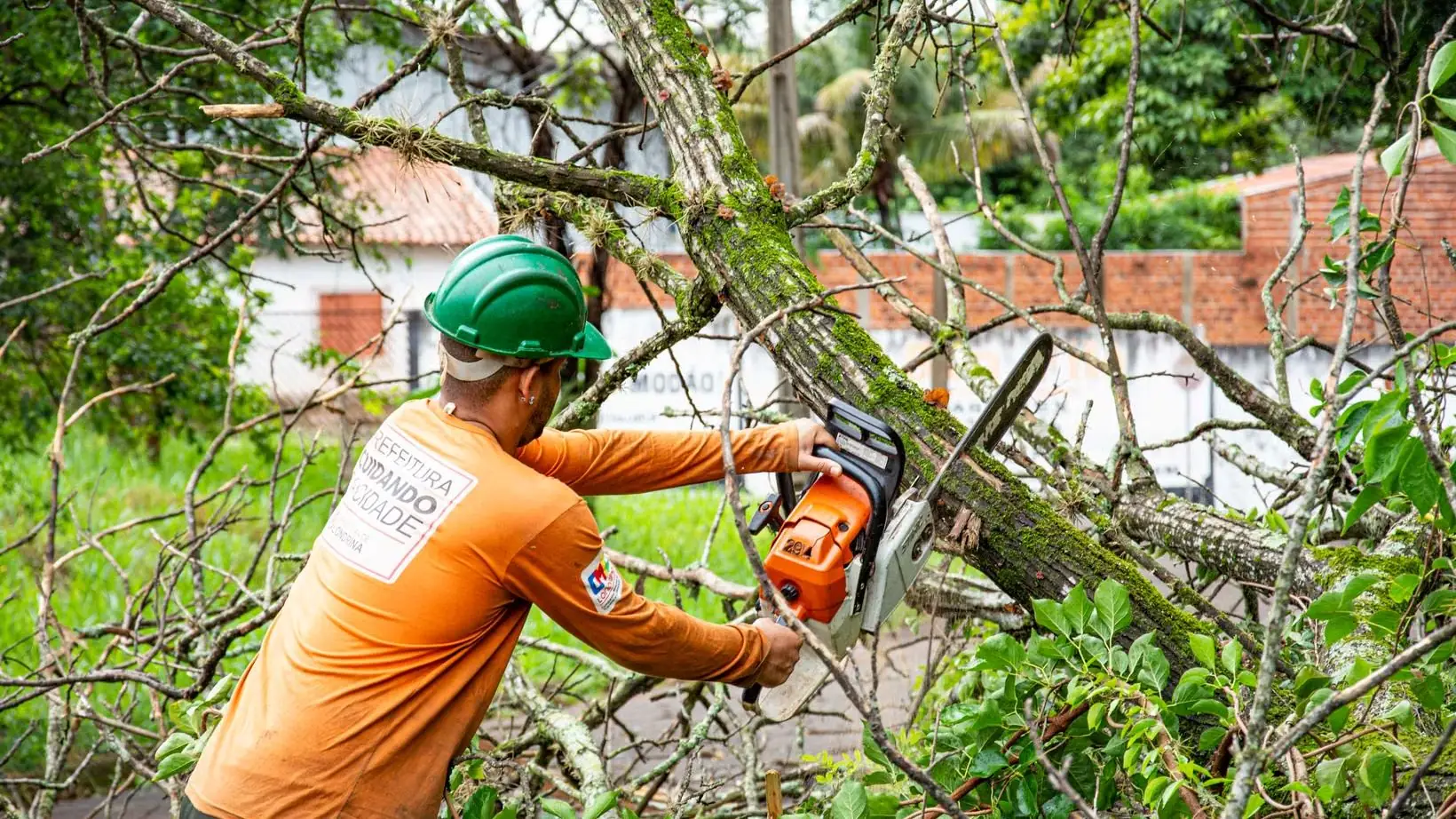
What pruning can change, and what it cannot
Pruning does a few things well. It takes weight off a limb that has grown longer than its attachment can comfortably carry. It removes wood already dead, cracked, hanging or rubbing, which is what comes down first in wind and ice. It improves structure by deciding which stems keep growing and which get held back. And it buys clearance from a roof, drive or walkway.
What it cannot do is make unsound wood sound. A column of decay inside a trunk is untouched by removing branches, and a cavity stays a cavity. Pruning does nothing for a root problem either. Where limestone sits close to the surface, roots that cannot go down spread outward in a shallow plate instead, and a tree with no decay in it anywhere can still tip in saturated soil and high wind, lifting a circle of turf as it goes.
So the first question on any visit is whether pruning is the answer at all. Sometimes it is deadwood and nothing else, and sometimes the defect is structural enough that the real choice lies between a substantial reduction and removal.
Where the cut goes is the whole technique
Trees do not heal. Animal tissue repairs damage by replacing it; a tree cannot replace anything. It compartmentalizes instead, walling the injury off chemically, sealing damaged wood away from the wood still conducting sap, then growing new tissue over the outside. The old wound never becomes live wood again. It gets buried, and that decides where every cut belongs.
At the base of almost every branch sits a slightly swollen ring called the branch collar, with a raised line running down the trunk on either side of the union called the branch bark ridge. The collar is where trunk and branch tissue overlap. It carries the chemical barrier the tree uses to shut a branch off, and it grows the callus that closes the wound from the outside in. A cut just outside the collar, angled to follow it without slicing into it, leaves that defense intact.
A flush cut removes the collar, and with it both the barrier and the tissue that would have closed the opening, and it leaves a wound larger than the branch was, because cutting flush to a round trunk cuts an oval. That is why trees pruned neatly twenty years ago have soft hollows at old branch positions today.
The opposite error is a stub. Inches of branch left beyond the collar put the cut face out on branch wood, away from any tissue that can close it, so the stub dies back, and dead wood standing in the rain is a wick for decay working toward the trunk.
A limb heavy enough to tear comes off in three cuts: an undercut well out from the union, then a cut from above just beyond it to drop the weight, then the final cut at the collar. Taking it in one pass tears bark down the trunk, a worse wound than the cut itself.
Why topping fails, and what works instead
Topping means cutting leaders and large limbs back to stubs at whatever height a saw reaches, with no regard for branch unions. It is still sold as a safety measure and it is the reverse of one. A tree lives on what its leaves make, so taking most of the canopy at once removes the factory and forces the tree into reserves it cannot quickly replace, and stressed oaks here are where Hypoxylon canker turns up. Heading cuts also land mid-stem, nowhere near a collar, so there is no barrier and no closing tissue, and those large faces decay inward for years.
The regrowth is the part homeowners do not expect. Cutting a leader off destroys the hormonal signal keeping dormant buds quiet, and they break at once into a dense brush of fast upright shoots called water sprouts. An ordinary branch grows from the center of the stem outward, its wood knitted into the trunk; a sprout arises near the surface, anchored only in the outer layers, on a stem now decaying beneath it. Within several years that regrowth is taller than the crown removed, denser and far more weakly attached, so more comes down in the next ice load, not less.
A tree simply too large for its space cannot be made smaller by topping. Where height or spread genuinely has to come down, the technique is reduction: the cut goes back to a living side branch already heading in a useful direction and large enough to take over as the new end of the limb, commonly at least about a third the diameter of the stem being removed. That lateral keeps the limb supplied, keeps growth heading outward instead of exploding into sprouts, and gives the cut a collar to close against.
The pruning types, and how much is enough
Trade practice sorts pruning into a few named operations, and knowing them turns a vague request into a specific one. Cleaning removes dead, dying, broken and crossing wood and nothing else, which makes it the lowest-risk pruning there is and the right default on a mature tree. Thinning removes selected live branches throughout the crown to let light through and let wind pass rather than push, and its discipline is that cuts are spread evenly rather than concentrated where they are easy to reach. Raising takes off the lowest branches for headroom underneath.
Dose is the other half of the decision. Every live branch removed is leaf area removed, and leaf area is how a tree pays for root growth, wound closure and next spring's flush. A small share off a vigorous tree disappears without visible response; a large share forces the tree into stored reserves, and the results surface over the following two or three years as thin pale foliage, dieback at the tips, sprouts along the inner limbs, sometimes sunscald on long-shaded bark.
Age sets the limit. A young tree carries much of its mass in leaves and recovers from heavier pruning quickly, while a mature tree supports a great deal of trunk and root on a canopy no longer expanding, and trees stressed by summer drought on thin soil tolerate the least. Dead wood sits outside this budget entirely, since a limb that is already dead costs the tree nothing to lose.
- Cleaning: dead, broken, hanging and rubbing wood removed
- Thinning: selected live branches for light and wind movement
- Raising: lower limbs removed for clearance underneath
- Reduction: height or spread cut back to living laterals
Structural pruning while the tree is still small
The cheapest risk reduction in all of tree care is a few minutes of pruning on a young tree, and almost nobody does it. The aim is to establish one dominant leader and keep it dominant. A young shade tree left alone often develops two or three stems of nearly equal size racing each other upward, and those stems are what gets cut out of the same tree with a crane in forty years.
Most of the work is subordination rather than removal. A competing stem is shortened so it falls behind the chosen leader, which lets the leader take over without a large wound or a hole in the crown. Narrow forks are reduced or removed while the cut is still the size of a thumb, and branches that will be in the way of the eventual roof or drive come off early, in stages. These cuts close within a season or two, because the wounds are small and the tree is growing fast.
A short visit every few years for the first couple of decades covers it: the leader, the forks, and branches heading somewhere they cannot stay. In a region that gets freezing rain, that is the difference between a tree that stays whole and one that splits.
Included bark and codominant stems
A normal branch union is strong because branch wood and trunk wood overlap and interlock there, year after year, and the branch bark ridge is the sign of it.
When two stems of similar diameter rise side by side at a very narrow angle, there is no room between them for that interlocking. Each lays down its own bark on the inside face of the fork, and the bark gets trapped in the seam. This is included bark. The stems press hard against each other, which can feel solid to the hand, but little or no continuous wood joins them, and as both thicken they act as wedges prying the union apart from the inside. The signs are a fork with no ridge in it, sometimes a raised seam, and in advanced cases a crack running down from the crotch.
Two local species show the defect constantly. Bradford pear is built almost entirely out of these tight seams, which is why it eventually comes apart in a storm. Silver maple is the other, fast and weak-wooded, prone to the same crowded unions. On either one, a pruner is managing a flaw rather than correcting a habit.
What can be done depends on size. On a young tree, subordinating or removing one of the two stems settles it permanently with a small cut. On a mature tree with a suspect union under heavy weight, the options narrow to reducing end weight above it, repeated as it regrows, or removal. A cracked union over a house with a full crown above it is a removal conversation, not a trimming one.
Timing around oak wilt and the flowering trees
For most hardwoods here the dormant season is the best window, and not only because the tree is idle. With leaves off, the structure is visible from the ground: crossing limbs, tight forks, seams, deadwood and the true shape of the crown. Decisions made on what can actually be seen are better decisions, and a cut made late in dormancy sits exposed only briefly.
Oaks are the exception that matters most locally, because oak wilt is present in Missouri. The disease moves between trees partly through sap-feeding beetles, and a fresh pruning wound in warm weather is the beacon they answer. The practical rule keeps saws out of oaks from roughly April into midsummer. A cracked or hanging limb over a walkway is still dealt with immediately, but scheduled oak pruning waits for dormancy.
Spring-flowering trees run on another clock. Redbud and flowering dogwood set the buds that open in spring during the previous summer, so anything cut in winter is flower buds in the brush pile. Pruning them shortly after they finish blooming keeps the display and still leaves most of a season to respond.
Clearance over lines, roofs, drives and pools
One category of trimming is not a homeowner's to hire out at all. Branches reaching into overhead electric lines are the utility's to cut, and in Springfield that responsibility rests with City Utilities. Make a report instead of collecting quotes. A curbside tree can be outside a homeowner's control for a different reason: the planting band past the walk is usually municipal ground, which puts pruning decisions with city hall.
Everything else is easier to specify as a finished measurement. Over a roof, the goal is that limbs do not touch the surface when they move. Branches resting on shingles grind them with every breeze, and a limb clearing the roof by a foot in calm air is on it in a thunderstorm and pressed down under ice. A few feet of air in still conditions is the realistic target, reached where possible by reducing the limb to a lateral rather than removing it at the trunk.
Over a driveway, the finished height should suit the tallest vehicle that really uses it, meaning delivery and service trucks rather than the family car. Around a pool the question shifts from clearance to debris and light. Raising has a limit in every case: if reaching a clearance height would strip most of the lower crown off a mature tree, the clearance and the tree are not both available.
- State the finished clearance as a height, not as an instruction to cut back
- Reduce limbs to laterals where possible instead of removing them at the trunk
- Size driveway headroom for service trucks, not for cars
- Send anything in or near an electric line to the utility
Storm damage, and what a visit turns up
Ice is the defining tree risk around Springfield and it works differently from wind. Freezing rain coats every twig, adds weight uniformly across the whole crown, and keeps accumulating with no gusts to shake anything loose. The trees that fail first have many upright branches and tight forks, because upright wood catches the most ice per length and an included-bark union has the least holding it together. The January 2007 storm was severe here and its signature is still legible in the shape of older trees.
Some pruning genuinely reduces what comes down. Removing dead and broken limbs takes away the wood most likely to fail under any load, reducing weight above a defective union addresses the place a tree is most likely to come apart, and pulling end weight off an overextended limb shortens the lever. What does not work is the reflex to open a crown up so ice and wind pass through. Stripping out the interior and leaving foliage bunched at the tips, sometimes called lion-tailing, moves weight to the end of the longest lever and leaves limbs whippy with nothing inside to damp their motion.
A trimming visit also puts eyes on the crown from a few feet away. Bagworms on eastern red cedar and juniper are the standing example: small spindle-shaped bags of silk with bits of needle woven on, holding caterpillars that feed inside them. They matter on cedar and juniper because these do not refoliate the way a hardwood does, so repeated heavy feeding can leave brown sections that never fill in. Picking the bags off by hand while they are few is the simplest answer.
How to write a request two quotes can answer
Trimming proposals are hard to compare because the same three words cover very different amounts of work. Describing the finished condition instead of the activity fixes that, and it protects the tree: a proposal that names the cut type cannot quietly become a topping job.
A description worth signing identifies which limbs are involved and roughly how large they are, states the finished clearance as a measurement, names the cut type for each item, and caps how much live crown comes off. It should rule out topping, and rule out climbing spikes on a tree that is being kept, since spikes put a wound in the trunk at every step. It should also settle what happens to the debris, which is a real share of the labor.
- Which limbs, and roughly what diameter
- Finished clearance stated as a height over roof, drive or walk
- Cut type per item: cleaning, thinning, raising or reduction to a lateral
- A stated cap on live crown removal, and no topping
- No climbing spikes on a tree that is being kept
- How debris leaves: chipped and hauled, chips left, or wood cut and stacked
Tree trimming and pruning in Springfield, Missouri — common questions
How often should a mature tree be pruned?
Most established shade trees do well on a cycle of several years rather than an annual one, and the visit is usually a cleaning: dead, broken, hanging and rubbing wood out, with a light touch on live structure. Annual trimming is rarely useful on a mature tree and often means live crown is being removed that the tree did not need to lose. Young trees are the opposite case and benefit from a short structural visit every few years while the cuts are small. Storm damage and any limb that becomes a hazard get dealt with when they appear, not on a schedule.
Will topping a tall tree make it safer in a storm?
It reliably does the reverse. Topping removes the leaf area the tree lives on, leaves large wounds in the middle of stems where there is no collar to close them, and destroys the signal keeping dormant buds quiet. The response is a dense flush of fast upright sprouts anchored only in the outer wood of stems that are now decaying underneath. Within a handful of years that regrowth is taller and heavier than what was cut off and far more weakly attached, so more comes down in the next ice load rather than less. Where height genuinely has to come down, reduction back to living laterals is the technique that works.
When is the best time to trim trees around Springfield?
The dormant season suits most hardwoods here. With leaves off, tight forks, seams, crossing limbs and deadwood are all visible from the ground, so the decisions are better, and a cut made late in dormancy starts closing as soon as growth resumes. Oaks are the exception: because oak wilt is present in Missouri and fresh wounds in warm weather attract sap-feeding beetles that can carry it, scheduled oak pruning belongs in the dormant season, outside the window that runs roughly from April into midsummer. Redbud and flowering dogwood set their buds the previous summer, so prune those just after they bloom.
Can an oak be pruned in summer if a limb is a problem?
Yes, when the limb is an actual hazard. A cracked, hanging or dead limb over a driveway, walkway or play area is a present danger, and waiting months for dormancy trades a certain risk for a possible one. The restriction on warm-weather oak pruning exists because fresh wounds can attract the beetles associated with oak wilt, so the sensible approach limits summer work on oaks to what safety requires, leaving optional shaping until the tree is dormant. Clean cuts just outside the branch collar matter as much in July as in January, and so does keeping the number of wounds down.
Why do Bradford pears split apart, and can pruning prevent it?
The species grows fast and forks repeatedly into stems of matched size crowded into a narrow angle, which leaves no room for trunk and branch wood to interlock. Bark fills the seam instead, the stems merely press together, and as each thickens it wedges the joint open from inside until a storm finishes it. Pruning helps at two very different scales. On a sapling, cutting back or removing a competing stem settles the structure permanently. On a mature specimen, taking weight off the ends above a suspect seam lowers the leverage acting on it, which buys time without repairing anything.
Who trims branches growing into power lines?
The utility does. Anything in or near overhead electric lines is line-clearance work, handled by crews trained and equipped for energized conductors, and in Springfield that duty sits with City Utilities. A homeowner should report the branches rather than hire a general tree crew for them, and no ordinary crew should be working in a conductor. The span running from the pole to the house is worth asking about specifically, because responsibility for that drop is not always the same as for the lines along the street. Pruning elsewhere on the tree can proceed once the line portion is in the right hands.
Does thinning a crown reduce ice and wind damage?
Parts of it do. Removing dead and broken limbs takes away the wood most likely to fail under any load, reducing weight above a defective union addresses the place the tree is most likely to come apart, and pulling end weight off a long limb shortens the lever. What does not help is stripping the interior out and leaving foliage bunched at the branch tips, which puts weight at the end of the longest lever, leaves limbs whippy with nothing inside to damp their motion, and provokes sprouting. Pruning also cannot help a shallow root plate, which is what fails in a windthrow on thin soil.
Talk through your site
Start with the address, what you want done, and a few photographs of the area, including anywhere water sits after a heavy rain.
Related work
Tree Removal
Taking a tree down safely when it is dead, failing, or standing too close to something it can reach.
Stump Grinding & Removal
Grinding a stump out, how deep is deep enough, and what to do with the hole and the chips.
Storm & Ice Damage
Ice loading, straight-line wind and windthrow, and what to do with a tree that is already leaning on something.
Tree Health & Disease
Reading decline in oak, ash and pine on thin Ozarks soil, and telling a treatable problem from a hazard.
Lot & Land Clearing
Opening up overgrown acreage, fencelines and building sites, including honeysuckle and cedar.
Across the metro
Nixa
Christian County subdivisions carved out of old oak woodland, with mature trees left standing close to new houses.
Ozark
Finley River bottoms and steep wooded lots where sycamore and silver maple grow fast and fail early.
Republic
Open prairie edge west of Springfield, where wind arrives with nothing to slow it down.
Willard
Rolling pasture and fencerow cedar north of town, with hedge and volunteer trees crowding property lines.
Battlefield
Established southwest-side neighborhoods with large old post oaks over roofs and driveways.